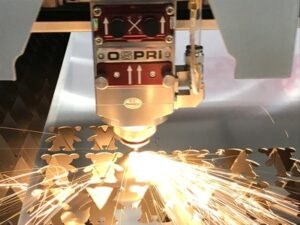
The laser cutting line, with its core advantages of no mold, high flexibility, and automation, has become a new and efficient production choice for small batch sheet metal processing. The following is a comprehensive analysis from technical characteristics, industry value, to landing benefits:
1、 Core Advantage: Why is it a “disruptor” in small batch processing
- Completely bid farewell to mold costs and achieve “one click production change”
Traditional stamping and material cutting lines require the development of separate molds for each product. In small-scale production, the cost of mold opening is high and the mold replacement cycle is long (such as the trial production of a new car model, which requires several weeks of mold opening and costs over one million). The laser cutting line does not require physical molds, only needs to switch CAD drawings and processing programs in the CNC system, and can complete the production conversion of different products in minutes, perfectly adapting to the market demand of “multiple varieties, small batches, and short cycles”.
- Increase material utilization by 5% -15%, directly reducing production costs
Through an intelligent nested layout system, the laser cutting line can optimize the cutting scheme of coil materials and reduce the loss of material heads and tails during single piece cutting. Industry data shows that after adopting this technology, the material utilization rate can be increased from 85% in traditional processes to over 92%, especially in the processing of high priced materials such as high-strength steel and aluminum alloys, where cost savings are more significant.
- Adapt to complex designs and lightweight materials to meet high-end manufacturing needs
- Complex shape processing: It can accurately cut complex geometric shapes such as car covers (such as car doors, engine hoods), home appliance panels, etc., with smooth and burr free cuts, and can directly enter subsequent processes such as welding and spraying without the need for secondary processing.
Lightweight material adaptation: Contactless laser cutting avoids mechanical damage to sensitive materials such as aluminum alloys and high-strength steels (such as indentation and residual waste), meeting the processing requirements of the trend towards lightweight new energy vehicles.
- The entire process is automated, increasing efficiency by over 30% and reducing dependence on manpower
Integrate automatic unwinding, leveling, servo feeding, laser cutting, finished product stacking and other processes to achieve a fully automated closed-loop of “coil feeding → finished product unloading”. Taking 1mm material processing as an example, synchronous feeding during cutting increases efficiency by 30%, requiring only one person to operate 1-2 production lines, significantly reducing reliance on skilled stamping workers.
2、 Industry landing value: scale application from automobiles to home appliances
- Automotive manufacturing industry: core equipment for flexible production
Applied to the production of body coverings (doors, luggage compartment covers), battery casings, motor brackets and other components, supporting the processing of lightweight materials such as high-strength steel and aluminum alloys.
Shorten the launch cycle of new products by about 40%, helping car companies quickly respond to market iteration demands (such as shortening the update cycle of new energy vehicle models from 3 years to 1.5 years).
- Home appliance manufacturing industry: key support for customized production
Used for processing exterior panels and structural components of household appliances such as refrigerators, washing machines, and air conditioners, supporting various materials such as stainless steel, galvanized sheet, and color coated sheet.
In the customized production of advanced home appliances, it can quickly respond to design changes of different specifications and shapes, increase material utilization to over 92%, and increase production efficiency by 35%.
- General sheet metal processing: a “profit amplifier” for small batch orders
Undertaking small-scale business such as non-standard parts, trial orders, and maintenance spare parts, without the need to bear mold development costs, with a gross profit margin increase of 20% -30% compared to traditional stamping modes.
3、 Investment return: balance between short-term costs and long-term value
Although the initial equipment investment of laser cutting line is higher than that of traditional stamping line (about 30% -50% higher), the comprehensive benefits are significant:
- 1-2 year return on investment: By saving on mold costs, material costs, and labor costs, most companies can recoup their investment within 1-2 years.
Long term value: Release factory space (1 laser line replaces 3 laser cutting machines+unwinding machines+shearing machines+punching machines), reduce mold management costs, improve production capacity utilization, and provide core support for the flexible manufacturing transformation of enterprises.
Laser cutting line is not only a technological upgrade for small batch processing of sheet metal, but also a key equipment for the transformation of manufacturing industry from “rigid large-scale production” to “flexible personalized manufacturing”.