
The precision control of CNC technology for small-batch precision aluminum alloy parts requires the establishment of a closed-loop management and control system encompassing the entire chain from “material – clamping – parameters – cutting tools – quality inspection”. The core points are as follows:
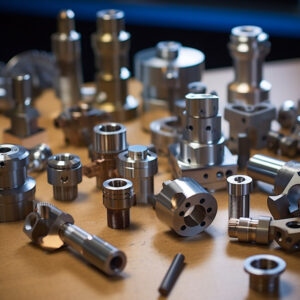
- Precise material pre-treatment: For commonly used aluminum alloys such as 6061 and 7075, the cutting is controlled by a CNC saw to ensure the flatness of the cut is ≤0.1mm/m, and the perpendicularity of the end face to the axis is ≤0.05mm. The forged billets undergo magnetic particle inspection to detect internal loose cracks, ensuring a hardness difference of ≤5HBS. Through material homogenization control, the dimensional stability after processing can be improved by 40%, laying the foundation for small-batch precision consistency.
- Efficient adaptation of the clamping system: Balancing the efficiency of small batch production changeover and clamping accuracy, modular quick positioning fixtures or profiled vacuum suction cups are adopted to replace traditional mechanical clamping. For example, vacuum suction cups are used for clamping thin-walled aluminum alloy parts to avoid part deformation caused by clamping force. The clamping repeatability accuracy can reach ≤0.005mm, adapting to the needs of small batch production with multiple specifications.
- Fine adjustment of machining parameters: Match parameters according to the grade of aluminum alloy. For example, when machining 7075 aluminum alloy, use a φ12mm carbide end mill, set the spindle speed to 10000r/min and the feed rate to 1800-2200mm/min; control the cutting depth in layers, with rough machining at 3-5mm, semi-finishing at 0.5-1mm, and finishing at 0.1-0.2mm; enable S-shaped acceleration and deceleration control for curved surface machining, reduce the acceleration to 3m/s², minimize contour errors caused by inertial impact, and stabilize the dimensional tolerance within ±0.005mm.
- Dynamic management and control of tool life: In small-batch production, tool wear is inspected every 50 pieces of machining, and tools are replaced promptly if the wear exceeds 0.01mm. Equipped with a tool life management system, it predicts wear trends based on cutting time and load current, and issues an early warning 10% of the tool’s lifespan in advance, which can improve dimensional consistency by 35%.
- Full-process quality inspection feedback: The first piece undergoes full-size scanning using a three-coordinate measuring machine. During the process, 3 pieces are sampled for inspection every 30 pieces. The built-in probe provides real-time data feedback and automatically compensates for tool wear. A small batch processing parameter database is established to iteratively optimize the process for the next batch, forming a closed-loop for precision control。
Metalstar looks forward to collaborating with you!