
1、 Analysis of the causes of hole deformation
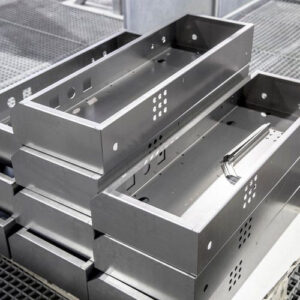
The deformation of the hole position is mainly caused by the redistribution of internal stress in the material during bending. When the bending line passes through the hole area, material flow causes distortion of the hole shape, ranging from slight increase in ellipticity to severe distortion of the hole wall. The degree of deformation is closely related to the aperture size, distance from the bending line, and bending sequence. If process planning is not carried out for small-scale processing, hole deformation often becomes the main cause of batch defects.
2、 Solution for hole deformation
Process optimization is the fundamental solution. The ideal approach is to complete all hole processing first, and then perform bending forming to avoid secondary heat effects after bending. If the hole position must be close to the bending line, it is recommended to use a step-by-step process of “bending punching re bending”, gradually releasing internal stress through secondary forming. Special process hole design can also effectively buffer deformation by adding process reduction grooves or transition corners around the hole position to disperse stress concentration areas. In addition, for high-precision hole positions, secondary processing through precision punching or reaming after laser cutting can be considered to ensure the final shape and position accuracy.
3、 Quality assurance measures
It is recommended to establish a first piece inspection system for small batch processing, by measuring the actual hole position coordinates through three coordinate measurement or profile inspection instrument, and quickly adjusting the process parameters after comparing with the theoretical values. At the same time, a process knowledge base should be established to accumulate empirical data on hole deformation of different materials, thicknesses, and structures, gradually improving process stability.
Core point: The key to hole deformation lies in “process optimization+stress dispersion”. Although it is difficult to test molds in small batches, stable high-precision delivery can still be achieved through refined process design and first piece verification.